
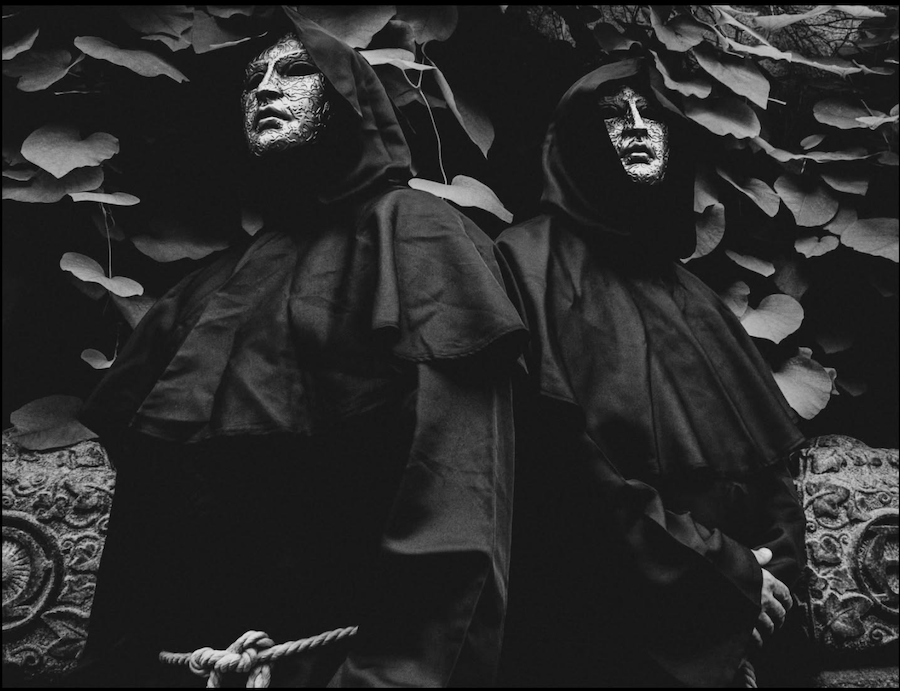
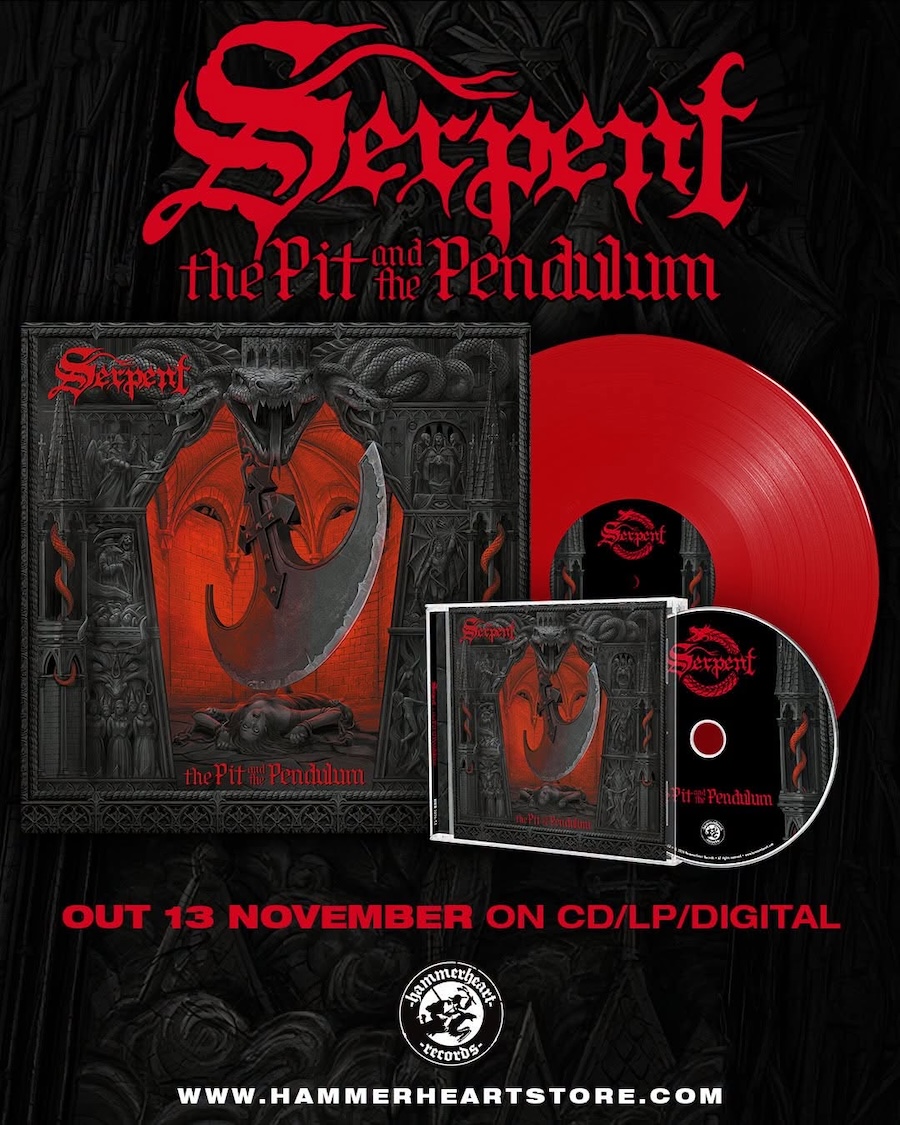
 Swedish band SERPENT are one of those groups whose history is at least as fascinating as their music. Although they were formed back in 2000, they had to wait more than two decades to release their first full-length album. What makes their story even more remarkable is that, after all those years, they have returned with a record that certainly doesn’t feel like a belated attempt to make up for lost time. “The Pit and the Pendulum” absolutely blew me away as a melodic death metal album. It offers precisely the kind of musical combination I enjoy: strong melodies, plenty of aggression, a majestic atmosphere and a darkness that permeates the entire record. SERPENT also aren’t afraid to explore historical and occult themes, while keeping their music natural, powerful and uncompromising. I consider their debut an exceptionally strong release and undoubtedly one of the most pleasant discoveries of recent times. I spoke with the band’s bassist and vocalist Sin, whose real name is Kenneth Alutoin, about SERPENT’s history, present and musical ambitions.
SERPENT was formed back in 2000, which means the band has been around for more than two decades. Could you take us back to the very beginning? What brought you together, what were your original ambitions, and what kind of musical vision did you have when you started?
Jens Dyme and I had been close friends for many years before SERPENT came into existence. We had previously played together in the nineties in a horror hard rock band, influenced by KISS, WHITE ZOMBIE and MISFITS e.t.c and our stage presence was zombies and we primarily performed live on Halloween, combining cover versions with our own original compositions. Following the recording of a demo, however, certain musical differences began to surface, and it eventually became apparent that we were heading in different directions. The band subsequently dissolved, but Jens and I remained determined to pursue our own musical ambitions.
SERPENT was born out of that decision in 2000. From the outset, we had a fairly distinct idea of what we wanted to achieve musically. Our foundation was melodic death metal, but with the ferocity and aggression of thrash metal, the grandeur of traditional metal and the atmospheric dimensions of symphonic black metal.
Your history is quite unusual. During the first years of your existence, you released as many as six demos, yet a full-length album never materialised. How did SERPENT actually function during that period? Were you a regular band rehearsing and writing new material, or was it more of an underground project that came together whenever circumstances allowed?
We were a functioning band in the traditional sense. We met regularly,and continuously worked on new material. There was a genuine commitment to developing SERPENT, and the six demos we released during those years were the result of a considerable amount of creative work.
The principal obstacle was financial rather than artistic. We simply didn’t have the resources to book professional studio time, so we had to make the best of the recording equipment and technology available to us at the time. We recorded our demos at home, although the limitations of the equipment inevitably compromised the sound quality. We were working with what we had, rather than what we would have liked to have had.
We did establish contact with a few very small independent record labels, and there were occasional possibilities on the horizon, but unfortunately, none of those discussions ever developed into anything substantial. A Canadian escape artist began using tracks from our demos as musical accompaniment during his escape performances. At one point, he performed an escape act live on Canadian television, and they played our song “The Pit and the Pendulum”.
 There seems to be a certain fascination among underground metal fans with old demos, especially when it comes to bands that never released a proper full-length album. How do you perceive the interest in your early recordings today? Do you think the demos have acquired a certain cult status over the years, and are you surprised that people still remember and appreciate that material?
In our case, the technical limitations of those recordings are fairly obvious. Nevertheless, the demos generally received favourable reviews in the demo sections of the metal magazines of that period, which was extremely encouraging.
I wouldn’t necessarily presume to declare that our recordings have achieved cult status, as that’s ultimately something for listeners to decide. However, it’s genuinely gratifying to discover that people still remember the material, revisit those demos.
Looking back at your early years, do you feel that the music you created back then already contained the foundations of what we can hear on The Pit and the Pendulum? Or has your musical identity changed considerably over the years?
I would say that the foundations were already firmly established in those early years. From the very beginning, SERPENT has been fascinated by real historical events, the occult rituals and necromantic practices of the medieval world, exploring those darker intersections where history, mysticism and the forbidden converge.
One question that immediately comes to mind is why it took SERPENT so long to release a debut album. Was it mainly a matter of personal circumstances, lack of time, changing line-ups, musical perfectionism, or simply the fact that releasing a full-length album was never your primary goal?
A full-length album was always the goal. It was never a question of lacking ambition. Rather, life and circumstances simply took us in different directions at various points along the way. Around the time I got enrolled at film school, Jens wanted to explore other musical directions. After graduating, I began working professionally with music video productions and commercials, which inevitably demanded a substantial amount of my time and creative energy. The demands of that work gradually took precedence, and SERPENT became less active as a consequence. However, we never formally disbanded, and I never considered the band to be something that had reached its conclusion.
What motivated you to finally take the material seriously, complete the recording process and turn SERPENT into a fully-fledged recording band? After so many years of existence without a proper album, did you feel that you owed something to yourselves, to the old fans, or perhaps to the music itself?
Following Jens’s departure, and with my own professional commitments increasingly centred around film school and later music video production and commercials, the band gradually entered a prolonged period of inactivity.
The turning point came later, when I met Kristian. He’s an exceptional musician and an equally remarkable individual. As we got to know each other, it became increasingly apparent how many similarities there were in our respective backgrounds. We had attended many of the same concerts over the years, gravitated towards much the same music and developed a strikingly similar appreciation of cinema. In a sense, we had been moving along parallel paths for years, sharing many of the same influences without ever having met.
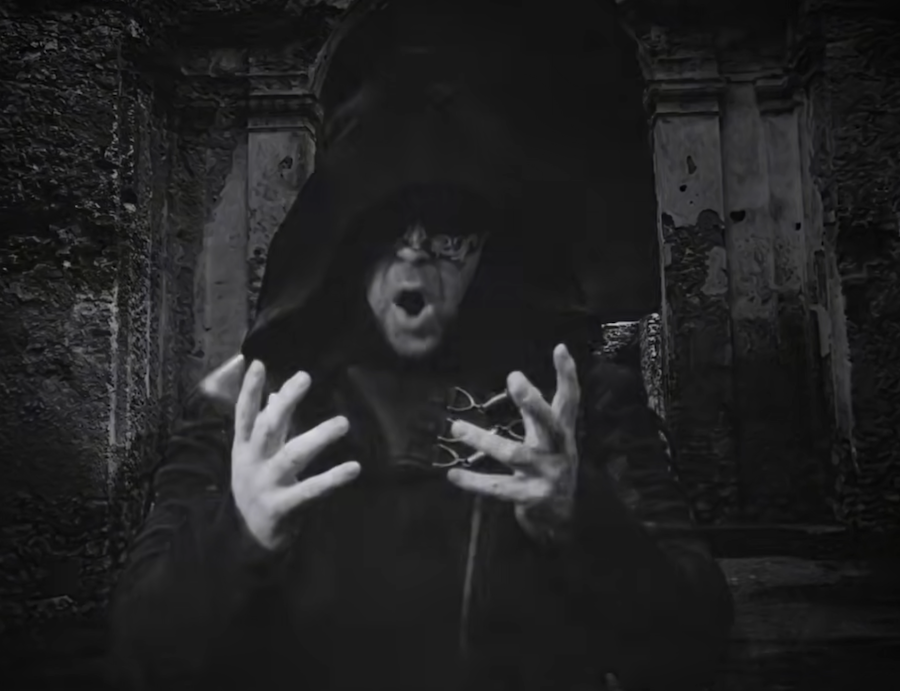
That common ground gave us a natural starting point, both creatively and personally, and made it possible to develop a musical partnership built on a shared frame of reference.The initial catalyst for SERPENT’s revival began with my desire to revisit and re-release two music videos, “Beneath the Forest of the Dead” and “Cross of Hate”, which we had filmed during long nights in the mid-2000s, when I was studying at film schoolAt the time, I had access to the school’s facilities and equipment outside regular hours, which allowed us to undertake projects that would otherwise have been financially impossible. The video for “Beneath the Forest of the Dead” features Swedish actors Jessica Forsberg (Harry’s Daughters, Parterapi, Knutby) and Ola Wahlström (The Girl Who Played with Fire, Behind Blue Skies).
However, the sound quality of our original home-recorded demos no longer met the standards we wanted to associate with the material. I therefore approached Kristian about re-recording the two songs featured in the videos, namely “Beneath the Forest of the Dead” and “Cross of Hate”. Neither composition appears on The Pit and the Pendulum, but both newly re-recorded tracks and their accompanying music videos are available on Spotify and YouTube.
Kristian re-recorded the songs, allowing us to re-release the videos with recordings that did the compositions considerably greater justice. The response was overwhelmingly positive, both in terms of the music and the visual material. More interestingly, some listeners began contacting us, asking whether SERPENT had any additional material. At that particular moment, however, our catalogue consisted largely of the original demos and the two newly re- recorded tracks. It became increasingly apparent that there was still genuine interest in the band. Kristian subsequently became part of SERPENT, and we began writing together.
Your debut album “The Pit and the Pendulum” is steeped in mysticism, occultism and some rather disturbing chapters of human history. Where did the initial concept come from? Was it something you had been fascinated by for a long time, or did the idea gradually emerge during the songwriting process?
Our fascination with these subjects predates the album by many years. Indeed, they have been intrinsic to SERPENT’s identity since the band’s inception. We’ve always been drawn towards the more obscure and unsettling aspects of history, particularly the intersection between religious authority, superstition, occult practices and humanity’s enduring fascination with death.
The album draws upon that particular historical and cultural landscape. We explore true historical events, occult rituals, necromancy, witchcraft, religious persecution and the various manifestations of fear and fanaticism that have accompanied humanity throughout its history. There is a certain cinematic quality to that approach, which is perhaps unsurprising given my background in filmmaking. For us, the most compelling aspect is the possibility of transporting the listener into another time and place through the combination of music, lyrics and atmosphere.
Several songs deal with witch hunts, religious fanaticism, the Inquisition and other dark historical events. What fascinates you about this particular period? Is it the historical reality, the atmosphere of superstition and fear, or perhaps the darker side of human nature that remains relevant even today?
What fascinates us is not so much the religious beliefs themselves, but what happens when belief becomes an instrument of authority, coercion and control.
I have very little objection to an individual’s personal beliefs or spiritual convictions, provided they cause no harm to others, be they human or animal. Freedom of belief is something I consider fundamental. Everyone should be entitled to their own convictions without having them imposed upon them by others.
The problem begins when individuals or institutions presume to speak on behalf of man-made gods and claim an unquestionable authority to dictate how others should live, think and behave. Once that happens, belief can become a justification for almost anything, including persecution, torture and murder.. We are not, and have never been, a political band, nor do we set out to comment on contemporary political affairs.
 The Czech Republic has a famous cult film called Witchhammer (Kladivo na čarodějnice), directed by Otakar Vávra in 1969. It depicts the witch trials in the Jeseník region during the 17th century and is a powerful portrayal of religious fanaticism, manipulation and mass hysteria. If you haven’t seen it yet, I would definitely recommend watching it. Have you ever encountered this film, and does this kind of cinematic interpretation of historical witch trials appeal to you?
I haven’t encountered Witchhammer (Kladivo na čarodějnice) before, but from your description it sounds like a particularly interesting film. Thank you for bringing it to my attention. I’ll certainly add it to my list of films to watch. During my time at film school, we watched “Häxan” (1922) and “The Passion of Joan of Arc” (1928) in class. Both films left a considerable impression on me and have been important sources of inspiration for SERPENT.
The album also touches upon the Salem witch trials of 1692 and the notorious English witch hunter Matthew Hopkins. How much historical research goes into your lyrics? Do you approach these subjects primarily as musicians looking for inspiration, or do you also find yourselves becoming genuinely absorbed in historical sources and documents?
I become genuinely absorbed in historical sources and documentation when developing our lyrical concepts. It is an integral part of the creative process. The historical material provides the foundation, while the music and lyrics allow us to interpret and recreate the atmosphere surrounding it. Ultimately, we want each song to feel as though it belongs to the particular historical world it portrays
Edgar Allan Poe’s The Pit and the Pendulum provides the title for your album. What does this particular story mean to you, and why did you choose it as the central title for the record? Does it represent the overall atmosphere and philosophy of SERPENT?
Edgar Allan Poe’s The Pit and the Pendulum was a particularly fitting choice for the album title,because of its historical association with the Spanish Inquisition, and true historic figures such as Tomás de Torquemada, its first Grand Inquisitor,
Our ambitions with every composition is to create the sensation that the listener has somehow been transported into the historical setting being portrayed. Through the interaction between the lyrics, musical arrangements and atmosphere, we want to evoke the feeling of actually being present at the location and during the period in which the events unfold.
Do you see the occult and mystical elements in your music merely as an artistic and lyrical aesthetic, or do any of you have a genuine personal interest in occult traditions, esotericism, mythology or the supernatural?
My interest in the occult and the supernatural extends beyond their purely aesthetic or artistic applications. I have always been fascinated by the boundaries of human understanding and by the possibility that our perception of reality might be considerably more limited than we tend to assume. I place little faith in gods of human invention, particularly those constructed by humanity and subsequently presented as unquestionable authorities over human existence. Nevertheless, I remain firmly convinced that there are forces, phenomena and aspects of existence that lie beyond the current reach of rational explanation. I suspect that many people have experienced something inexplicable at some point in their lives, only to dismiss it, rationalise it or seek refuge in a more familiar explanation. What may ultimately remain beyond our comprehension is what makes these subjects fascinating.
How do you perceive the current Swedish death metal scene? Do you think the country still maintains the same creative energy and underground spirit that made its extreme metal internationally respected, or has the scene changed considerably compared to the 1990s?
The Swedish metal scene has undoubtedly evolved since the 1990s, as has the international metal landscape as a whole. Nevertheless, I don’t think Sweden has lost its creative vitality or its ability to produce distinctive and internationally respected metal.
HYPOCRISY is still going remarkably strong and continue to deliver awesome records. IN FLAMES’ most recent album represented something of a return to the territory of our favourite period, “Whoracle” , “Colony” and “Clayman” . It had elements that reminded us of that era, while still incorporating a more contemporary approach to production and songwriting. ARCH ENEMY continues to deliver and it will be interesting to see how the band develops with Lauren Hart as their new vocalist. She’s an outstanding singer, and I think she is an excellent successor to Angela Gossow and Alissa White-Gluz. THE HALO EFFECT, featuring former members of IN FLAMES, are another band we hold in very high regard. They have managed to capture that classic Gothenburg melodic death metal sensibility while giving it a contemporary identity. ORBIT CULTURE are also doing some particularly interesting things, combining different influences into a sound that feels distinctly their own.
Kristian Niemann has an impressive musical background, particularly through his work with THERION and SORCERER. How important was his involvement in the rebirth of SERPENT? Did his musical experience bring new dimensions to the band’s sound, songwriting or overall approach?
Kristian’s involvement has been absolutely fundamental to the rebirth of SERPENT. He’s an exceptional musician, an extraordinarily gifted songwriter and, perhaps just as importantly, a genuinely great person to work with.What makes our collaboration particularly rewarding is the creative chemistry between us. We have a very open working relationship, with plenty of room for discussion, experimentation and constructive disagreement. Neither of us is particularly interested in protecting individual egos or insisting that an idea must prevail simply because it originated with one person. The music itself is what matters. We share the same fundamental ambition: to make SERPENT as good as it can possibly be. There is a mutual understanding that the band’s best interests must always take precedence over individual preferences.
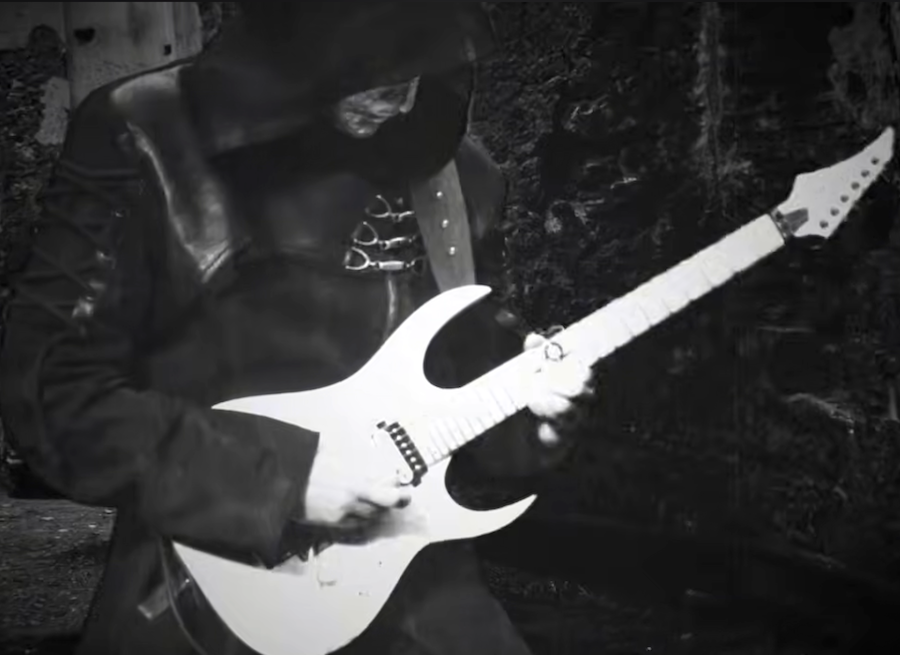
Your album features guest appearances by Anders Engberg and soprano Frida Cewrien-Sollerhag. What made you choose these particular voices? Did you already have a clear idea of how these guest contributions should sound, or did the collaborations develop spontaneously?
Once we had completed the compositions, we began considering whether certain songs might benefit from additional vocal contributions. We wanted to find voices that would not merely provide a variation in vocal texture, but genuinely enhance the individual character and atmosphere of each composition.
For “Necromancer”, Anders Engberg was an obvious choice. He possesses an exceptionally powerful and distinctive voice, with the kind of presence and character that the composition demanded. His vocal delivery brings an additional dimension to the song and complements its darker, more imposing atmosphere beautifully.
With “Season of the Witch”, we had a rather different vision. We wanted something that would contrast with the heavier elements of the composition and introduce a more ethereal, almost otherworldly quality.
Frida Cewrien-Sollerhag’s magnificent soprano proved to be precisely what the song needed. Her contribution elevates the composition into a distinctly different realm, adding a ritualistic and occult dimension
The artwork by Gyula Havancsák perfectly complements the dark historical and occult atmosphere of the album. How closely did you work with him? Did you provide a specific visual concept, or did he have considerable freedom to interpret the music in his own way?
We were involved in the creative process from the beginning and provided the initial conceptual framework for the artwork. This included a number of hidden references to the individual songs and their titles, which we wanted to incorporate into the visual composition. We wanted to include details and visual references that listeners might gradually discover as they became more familiar with the music and its lyrical themes. Gyula took those initial ideas and developed them considerably further, bringing his own artistic interpretation, imagination and attention to detail into the process.
After so many years, SERPENT finally have their first full-length album out. Does this release feel like the culmination of a very long journey, or do you see it more as a new beginning?
The culmination of an extraordinarily long journey and, simultaneously, a new dawn for SERPENT.
What are your plans for the future? Can we expect SERPENT to become a more active band, with concerts and new recordings, or will you continue to operate at your own pace, just as you did during the early years?
We have already begun laying the foundations for our forthcoming albums. This marks the beginning of a new chapter for SERPENT.
And finally, looking back at everything SERPENT has experienced since 2000, is there anything you would do differently? Or do you believe that all those years of silence, demos and unfinished plans were actually necessary to bring you to where you are today?
Had our financial situation been stronger in the early years, we would certainly have preferred to record the demos in a proper studio.
ALL