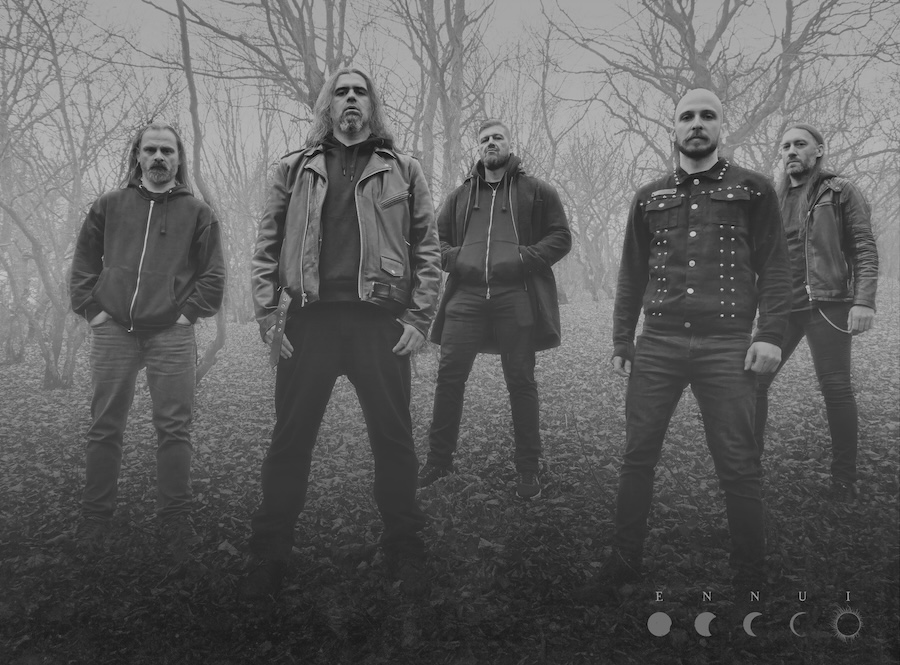
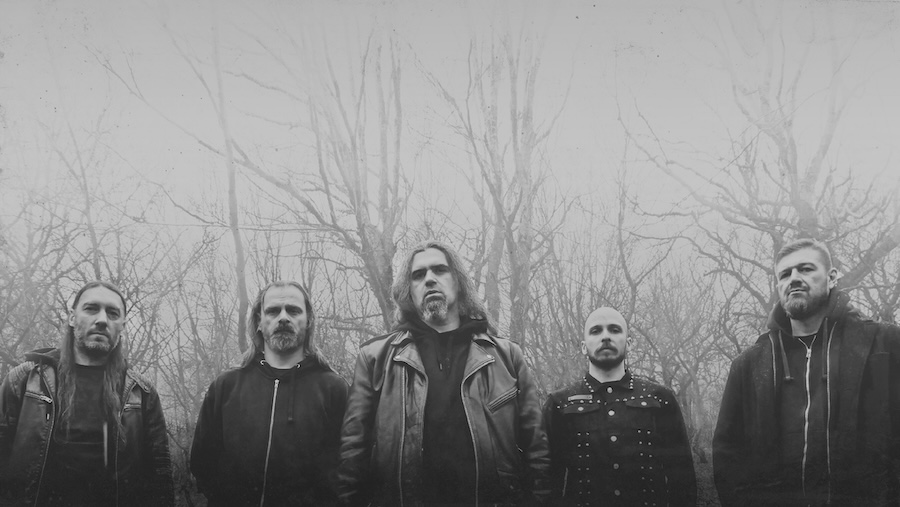
 After eight years, ENNUI returns with the album “Qroba,” whose extraordinary artistic imprint is so intriguing that I cannot simply overlook it. In my review, I praised this record as exceptionally powerful and convincing, and that was one of the reasons for the following interview. The interviewee was David Unsaved, the main creative force of the band, who speaks openly about the long journey to the new release, existential themes of emptiness and disappearance, as well as the influences of Georgian poetry and culture. ENNUI returns to the Rumzine website after about eleven years, and for the best possible reason…
David, the news about your new album really made me happy. The album “Qroba” is being released eight years after your previous album End of the Circle. Could you tell the readers what you have experienced during those eight years and how the band functioned during that period?
During those eight years, life happened. Sometimes generously, more often indifferently. In 2020 we played Haunting the Castle III in Belgium. It was our first European show, and for a brief moment it felt like a door had finally opened. New people, a different audience, and the feeling that our music could exist beyond its place of origin. That experience stayed with us. Shortly after we returned home, the world came to a halt. Lockdowns, uncertainty, silence. Like many others, we were forced to shift our focus away from music. Survival became more practical than artistic. Keeping our jobs and some basic stability mattered more than creative plans. Music continued in the background, whenever there was time and strength for it.
In 2022 and 2023 we slowly returned to rehearsals and began preparing new material. However, personal circumstances eventually led to the band dissolving completely. For a time, ENNUI simply stopped existing. Later, I decided to start again from nothing, without trying to restore what had already ended. I wrote new material without obligations to the past. Over time, that material shaped its own identity and direction. From this process the name “Qroba” emerged. The album is not a continuation of what came before, but the result of a restart.
Since 2012, you have been consistently working on building your good name, and gradually you have managed to gain recognition among listeners of funeral doom metal. Are you satisfied with ENNUI’s position on the scene? Could you have done even more within your possibilities?
I don’t think satisfaction is a useful state. At least, it has never worked well for me. There is always space to move further, to rethink things, to do something more precisely. I am rarely fully content with any result, not because I dismiss what has been achieved, but because perspective changes over time. Looking back at our early years, I see different people. Not better or worse, just shaped by a different understanding of things.
With experience comes a certain clarity. You begin to notice where more patience would have helped, where silence would have been wiser, or where less effort might have led to a better outcome. This kind of hindsight is probably not unique to me. I suspect most people who work seriously on something for a long time arrive at similar conclusions.
As for ENNUI’s place in the scene, I see it as a natural result rather than an objective in itself. We never tried to position the band strategically. Recognition came gradually, as a consequence of persistence and honesty, not ambition. Could we have done more? Possibly. But every path excludes other paths, and I have learned to accept that limitation as part of the process.
 Since your beginnings, you have been closely connected with the Russian doom metal scene. Your albums were gradually released by MFL Records and Solitude Productions, and thanks to that they reached practically the whole world. Do you still maintain contact with the local culture despite the current political situation?
Our cooperation with Russian labels belongs to an earlier phase of the band and effectively ended in 2018, when our album was released in Europe (Non Serviam Records). By that point, our direction had already shifted, and our paths had naturally diverged. What followed later did not cause this separation, but it made it final. The broader political events simply removed any remaining context in which such cooperation could exist. Not as a dramatic break, but as a matter of reality.
Culture does not exist in isolation from the world around it. It inevitably absorbs its time and circumstances. For us, this understanding is reflected in our choices and in the direction we continue to move forward.
Is the current isolation of metal culture in Russia a major complication for bands there?
I don’t feel qualified to speak on behalf of the current metal scene in Russia. We are not part of that environment, and we haven’t been following its internal dynamics for quite some time. In general terms, any form of isolation tends to limit exchange. Culture grows through movement, dialogue, and friction. When those channels are restricted, the effects are usually felt sooner or later. But how this plays out in specific local scenes is something only the people living and working within them can truly assess. From our perspective, it feels more honest to speak only about what we directly experience, rather than speculate from a distance.
And now to your new album. Could you reveal how long you worked on it? Is the album exceptional also because a broader lineup of musicians participated in its creation?
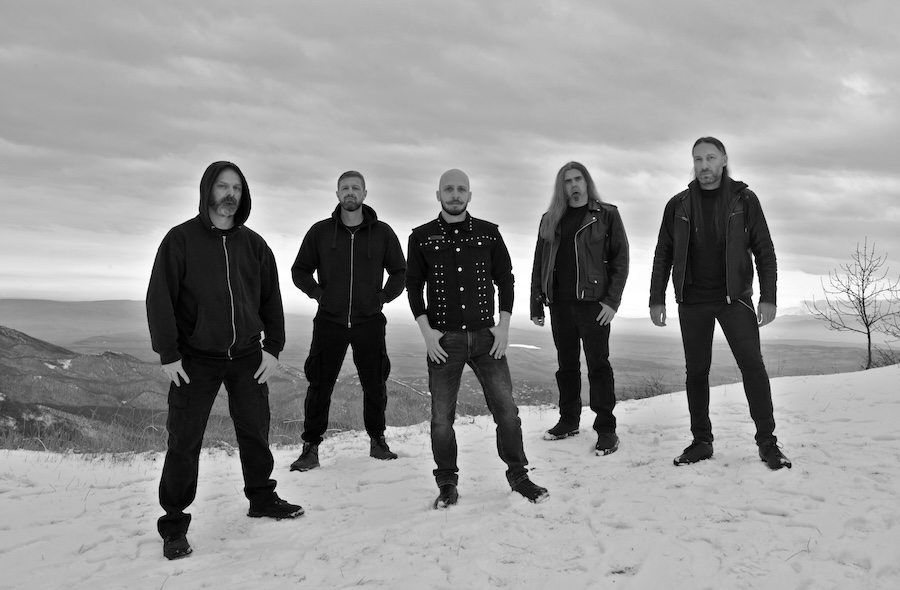
Traditionally, all the music for ENNUI has been written and shaped by Serge Shengelia and myself, regardless of the wider lineup at any given time. That internal core has always remained constant. With “Qroba”, the process was different. At the time the album began to take shape, Serge was not actively involved in the band, so I wrote the entire material on my own. That period lasted roughly a year of continuous, focused work. It was not planned as a conceptual shift, but rather a practical response to the circumstances at that moment.
Serge rejoined the process during the final phase and brought a fresh perspective to the material. His contribution, especially through his guitar solos, became an important part of the album’s final character. In that sense, the record carries both continuity and interruption within it. Our drummer, Alexander Gongliashvili, had been part of ENNUI as a live member since late 2019, but “Qroba” marks his first appearance on a studio recording with the band. This alone makes the album somewhat exceptional for us, as it captures a lineup coming together not in theory, but in practice.
“Emptiness, nothingness, disappearance…” These are the main pillars of the album “Qroba”. How did you arrive at this existential theme? Do you still remember the first pivotal moment that led you to choose this particular concept?
Themes such as emptiness, disappearance, and nothingness have always drawn me in, long before “Qroba”, and regardless of genre. I was attracted to them intuitively, not as provocation or negation, but as a way of looking at existence without consolation. That attraction has never really faded.
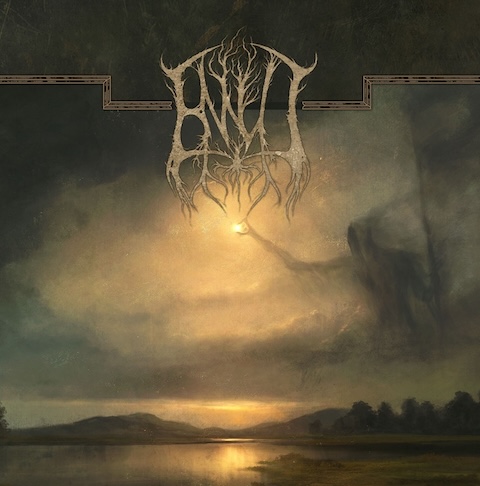
In ENNUI, this existential perspective was present from the very beginning. One of the earliest and most important reference points for me was the poetry of the Georgian poet Terenti Graneli. At a certain moment, it became clear to me that his language belonged within funeral doom metal. His epitaph reads: “No life, no death, but something else.” I don’t think this requires much interpretation. That sentence alone outlines a worldview. Across our albums, this underlying ideology has taken different shapes, but it has never disappeared. “Qroba” is no exception. It is simply another form through which the same questions are expressed. Following an older tradition within the band, “Qroba” also includes the work of another Georgian poet, Konstantine Makashvili. Several lyrics on the album are based on his poems, written after the death of his daughter, Maro Makashvili, who was killed during the Soviet invasion and occupation of Georgia in 1921 and later became a national symbol.
The texts used in “Decima”, “Down, to the Stars”, and “Mokvda Mze” reflect an overwhelming sense of loss, despair, and disintegration. The pain in them is not rhetorical. It gradually dissolves into something almost hallucinatory. I consider these poems exceptionally strong, because they articulate precisely the kind of existential experience that has always been at the core of ENNUI.
“Antinatalism” is the title of the opening composition, whose apt lyrics point to the core ideas of that philosophical movement. Personally, however, you have trapped me. If I “hadn’t wanted to be born,” I wouldn’t be able to enjoy the new ENNUI record… 🙂 Advise me—how do I escape this vicious circle?
I think antinatalism only becomes problematic if it could undo what already exists. Since it can’t, enjoying music feels like a perfectly reasonable compromise. 🙂
Do you often think about your own death, or are you more intrigued by thoughts connected with the demise of our planet?
I think about my own death far more often than about the end of the planet. Not because I underestimate the latter, but because my own mortality is the only one I have direct access to. It is immediate, personal, and unavoidable. The death of the planet is an abstract idea, mediated by headlines, projections, and speculation. My own death, on the other hand, does not require imagination. It is already quietly present. Perhaps that is why it feels more honest to reflect on what is certain rather than on what is merely possible. The end of the world may come or may not. My own end will not ask for permission.
Can the album be understood as a kind of funeral for the last generation of people who were given the gift of walking on this planet?
I’ve never thought about the album in those terms, and it was certainly not conceived as a requiem for a particular generation. I tend to be cautious with large, apocalyptic narratives. History has shown that every generation is convinced it might be the last, and yet life, in one form or another, keeps going. “Qroba” is not concerned with predicting an ending on a planetary scale. It is much more modest and much more personal than that.
The album deals with disappearance on a human level. With things fading, ending, and being accepted without turning them into grand statements about the fate of the world. If the record feels like a funeral at all, it is not for humanity as a whole, but for certain illusions that quietly die long before any final catastrophe arrives.
Do you think life similar to ours exists somewhere else? Or do you perceive the origin of Earth as a kind of cosmic accident from which humanity emerged?
I don’t find much comfort in speculating about life elsewhere in the universe. The idea that we might not be alone is often presented as reassuring, but I’m not sure why. Even if life similar to ours exists somewhere else, it doesn’t grant us meaning, purpose, or relief. It only multiplies the same condition across a larger scale. What truly unsettles me is not the possibility that we are alone, but the realization that existence itself offers no explanation. We can describe the universe in numbers, distances, and probabilities, yet the question of why there is something rather than nothing remains completely inaccessible. Thinking about this too directly can be almost physically disorienting.
I tend to see humanity as accidental, unnecessary, and fundamentally insignificant within the broader structure of reality. Consciousness, however extraordinary it may seem to us, does not elevate that position. It merely makes us aware of it. In that sense, our loneliness feels absolute, not just cosmic, but existential. Whether there is life elsewhere or not changes very little. The silence at the center of things remains the same.
For me personally, the composition “Becoming Void” is absolutely extraordinary—its structures are breathtaking and flow into one another in an incredible way. Was an emphasis on detail— even within funeral doom metal—something you paid especially close attention to this time?
I’m glad you hear it that way. When I said that all the music on Qroba was written from scratch, that was only partly true. Becoming Void actually predates the rest of the album. Its core idea first appeared in 2016, and the composition reached its final musical form around 2019. The lyrics, however, were written much later, when the album itself was already taking shape.
This long gestation is probably the reason the piece feels so deliberate. I worked on it slowly and with particular care, allowing the structure to unfold rather than forcing it into a conventional shape. At the time, there was a strong influence from ESOTERIC, particularly in the way dynamics and riffs are allowed to shift, expand, and contract within the same composition, without breaking its internal flow. Within Qroba, Becoming Void can almost be seen as a title track, at least conceptually. It articulates the album’s central idea in the most direct way. That said, the same level of attention was given to the rest of the material as well.
Of course, not all metal fans understand funeral doom metal; for some, this music seems monotonous and unengaging. However, the album Qroba is very diverse across all its tracks. Do you think it could appeal to a broader group of listeners?
It would be genuinely nice if Qroba could resonate with people outside the usual funeral doom audience. I’ve already heard that some listeners who are not close to the genre connected with the album, and I find that encouraging. The record wasn’t written to be more accessible, only to be honest and coherent. If that honesty allows someone new to listen without resistance, I’m glad.
The final composition, “Mokvda Mze”, contains unusual melodies and motifs. Can we hear music inspired by Georgian folk here? I don’t recall hearing anything similar, especially in such a bleak form of doom metal…
Yes, the opening of Mokvda Mze features the panduri, a traditional Georgian string instrument. For a long time, I was interested in the idea of exploring something like Georgian doom metal, but without turning it into folk metal in a literal sense. The goal was never to quote folklore directly or decorate the music with ethnic elements, but to let Georgian melodic thinking and emotional gravity surface naturally within the language of doom.
There is a particular kind of sorrow and restraint embedded in our culture, something quiet and heavy rather than dramatic. Translating that feeling into doom metal felt intuitive. I’m glad it comes across subtly, without announcing itself, because that was exactly the intention.
In which formats will the album be released? Will the record be available in many European countries?
Qroba will be available in digital format as well as on CD, released as a 6-panel digipack with an 8-page booklet. The album is released by the Belgian label Meuse Music Records, so physical distribution across Europe is well covered. At this stage, these are the planned formats, and we’ll see how things develop further.
I noticed on your Facebook page that you have some interesting concerts coming up in 2026. Could you introduce them to us in more detail?
On February 28 we will return to Belgium to play at Haunting the Castle VI, which has become a truly iconic festival for this kind of music. It’s always a privilege to share the stage with such strong and dedicated bands, and this time it will also be the first time we perform alongside long-standing legends like MOURNFUL CONGREGATION.
Shortly after that, we are planning a small Caucasus tour, with shows in Armenia and Georgia, together with SHAPE OF DESPAIR. Being able to play these songs in that region, and to do it in the company of a band we deeply respect, feels especially meaningful. If someone had told me years ago that these concerts would become reality, I probably wouldn’t have believed it. Not because of ambition, but because some paths only reveal themselves much later.
Thank you very much for the interview. I’m glad you’re back—and with such a beautiful album…
Thank you for the thoughtful and engaging questions.
I’m glad the album resonates, and I believe there are still many interesting things ahead.
ALL